
Weighting (buoyancy check) is one of the basic procedures that must be performed before diving, much like equipment check — these are mandatory steps. Improper weighting can lead to major problems; having too little ballast weight is just as wrong as having too much.
Excess ballast causes difficulties in maintaining position at the surface (insufficient positive buoyancy even with a fully inflated BCD), while too little ballast will cause problems with descending or maintaining the proper descent/ascent speed. The easiest way to avoid all these problems is by performing a buoyancy check (also known as weighting check) before every dive.
A weighting check must be performed whenever any element affecting buoyancy has changed. This mainly concerns elements such as: exposure suit, cylinder, and weight belt. It also applies to changes in the environment: fresh water versus salt water.
The weighting check is performed in full equipment (wetsuit, belt, mask/snorkel/fins, BCD, cylinder, regulator). Important: all equipment must be properly assembled and checked by your buddy (safety check); you should hold the regulator in your mouth rather than the snorkel, which will eliminate problems in case of an accidental descent.
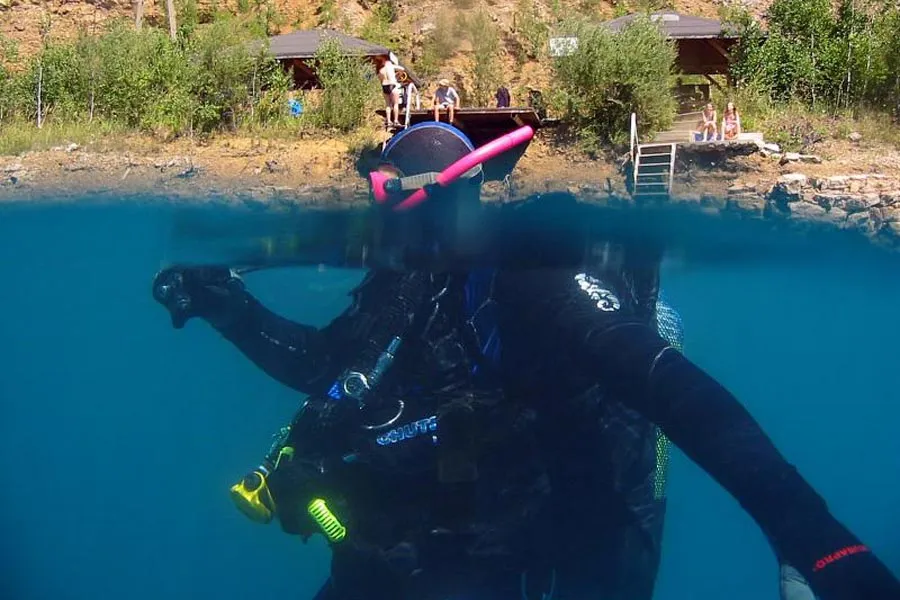
Proper weighting will change if you change your equipment. Buoyancy is heavily influenced by:
- Suit thickness — the thicker the wetsuit, the more ballast weight is needed,
- Cylinder — the weight of a cylinder in water depends on its size and manufacturer. Generally, the larger the cylinder capacity, the greater its weight in water. Aluminum cylinders of the same capacity as steel ones are about 2 kg lighter.
The goal of weighting is to select the amount of ballast so that it is as little as possible, while still allowing you to submerge and conduct the entire dive, including the safety stop during ascent.
When diving, we consume breathing gas, which is most commonly air, thereby reducing the weight of the air stored in the cylinder.
To avoid a situation where at the end of the dive we have positive buoyancy and therefore cannot maintain our position at the decompression stop and are pulled to the surface, you should carry an extra 2–3 kg of ballast.
The relationship between our buoyancy and ballast is described by Archimedes' principle. A cubic meter of air, which is 1,000 liters, weighs about 1.3 kg. If we have a cylinder of:
- 15 L, we have 15 L × 200 bar = 3000 L, which gives 3 × 1.3 kg = 3.9 kg,
- 12 L, we have 12 L × 200 bar = 2400 L, which gives 2.4 × 1.3 kg = 3.12 kg,
- 10 L, we have 10 L × 200 bar = 2000 L, which gives 2 × 1.3 kg = 2.6 kg.
If we use twin cylinders (twinset), the weight of the gas inside will be doubled:
- 2 × 15 L > 7.8 kg,
- 2 × 12 L > 6.24 kg,
- 2 × 10 L > 5.2 kg.
Of course, you should never consume all of your breathing gas completely; 30–50 bar should always remain in the cylinder — this is called the reserve. Dives exceeding recreational limits apply even stricter rules, such as the 1/3 or 1/2 rule.
Remember that ballast must be distributed symmetrically relative to the plane passing through the center of the chest (so that it does not roll you to one side). It is good when it is as far forward as possible (on the abdomen), as this lowers our center of gravity.
Jacket Buoyancy Check
You should enter water deep enough so that you cannot stand on the bottom and your fins do not touch the bottom. Your diving mask should be on your face and the regulator in your mouth. Get into a vertical position, take a full breath of air into your lungs, and dump all the air from your BCD jacket. The water level should settle at your eye height, and after exhaling, the diver should begin to sink. If the water is not at your eye level, you should add or remove weights until the required water level is reached. Unfortunately, this method only works with an empty cylinder, which makes it practically useless because where would you find an empty cylinder before a dive?
As we know, a 12 L cylinder contains over 3 kg of air, so if we dump all the air from the jacket, we will start to sink. How do we actually perform a buoyancy check in practice?
Enter water deep enough so that you cannot stand on the bottom and do not touch the bottom with your fins. Your diving mask should be on your face and the regulator in your mouth. Assume a vertical position, take a full breath into your lungs, and continuously deflate the BCD jacket using the inflator. You need to release enough air from the jacket to achieve neutral buoyancy at eye level. This is achieved fastest and easiest by deflating continuously using the inflator, stopping the release at mouth level; due to inertia and a slight delay, you will reach eye level within 1–2 seconds anyway. Check by touch with your hands how much air is inside the jacket; the jacket should be inflated to about 1/3 of its volume (3–4 liters of air, which counterbalances 3–4 kg of buoyancy). If everything is OK, after exhaling you should sink effortlessly. Done.
Now a few additional notes:
- The entire buoyancy check should be done quickly and efficiently because we perform it on a single breath; we exhale only at the very end to check if we sink. Yes, you understood correctly — we take a breath at the beginning and hold our breathing; every breath in or out will change our buoyancy and prevent a proper assessment of the situation. In other words, the buoyancy check is performed on a single breath.
- If the jacket is completely filled with air, you have too much ballast. By removing or adding ballast, achieve a state where the air content in the jacket is at about 1/3 of the jacket's total volume.
- In most cases, it is sufficient to weight yourself with an accuracy of 1–2 kg.
- The lower the buoyancy capacity of the jacket, the more precisely you must weight yourself (low capacity is about 10 L, high is about 20 L). Manufacturers state the buoyancy of a given jacket under ideal conditions, but the real buoyancy is lower by about 20%, which is 2–4 kg, due to the fact that a diver is inside.
Suprasternal Notch Weighting Method
Nowadays, even recreational divers are increasingly using wing systems. You might ask: is weighting in a wing done differently than in a jacket? The answer is not simple — we can perform the buoyancy check identically to the jacket method, but we will run into one major problem: we won't be able to check how much gas is inside the wing. The solution to this problem is to use a different, much simpler method: weighting to the level of the suprasternal notch.
Wing Weighting to the Suprasternal Notch Level
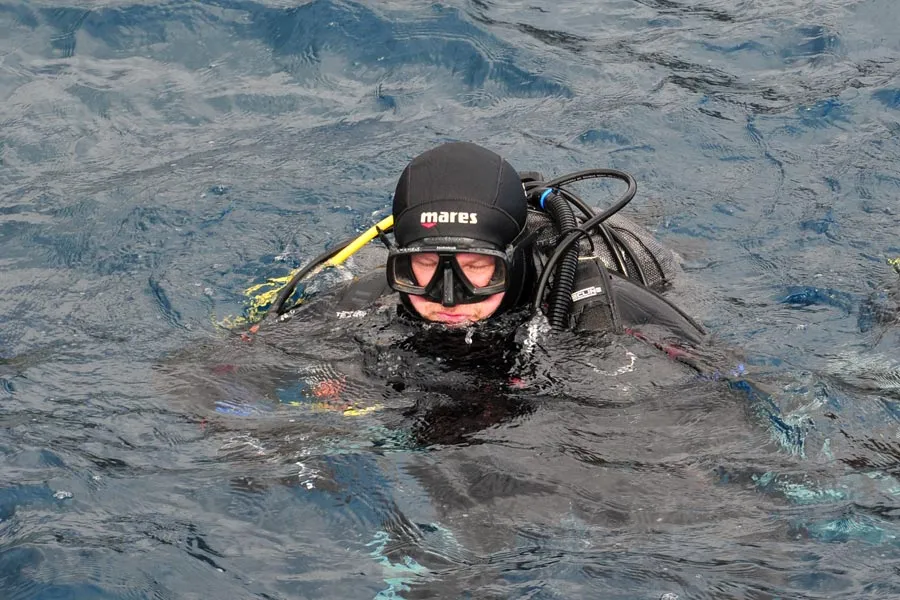
This method is very simple and requires virtually no training. Before entering the water, inflate the wing fully, put your diving mask on your face, and place the regulator in your mouth. Enter water deep enough so that you cannot stand on the bottom and your fins do not touch the bottom. Position your body vertically, do not hold your breath, and try to breathe normally. If you are perfectly weighted, the water level should be at the suprasternal notch — your entire head and entire neck should remain above water.
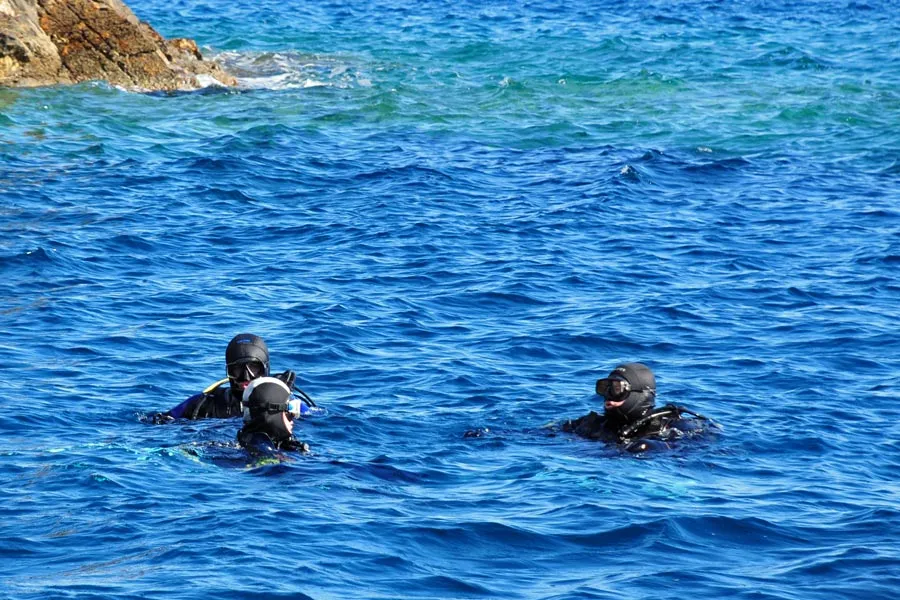
If you stick out to your chest, you most likely have 2–3 kg too little ballast and will not be able to submerge. If the water is at mouth level, you have at least 2 kg too much ballast; water at eye level means 4 kg too much ballast, and water at the top of your head means you are over-weighted by at least 6 kg. Adjust your ballast mass so that your buoyancy level is at the suprasternal notch. Once you achieve correct buoyancy, just to be sure everything is fine, finally check if you are able to submerge. If so, you're done — your weighting is correct.
Note
The suprasternal notch method can be used as described above when using a standard wing with a capacity of 13–15 liters for a single cylinder. With larger wings, naturally, once the wing is fully inflated, you will stick out of the water more, and the method must be slightly modified — each liter of wing buoyancy increases your lift by 1 centimeter (if you have a wing with a 20-liter buoyancy, the water level should be 5 cm below the suprasternal notch). You should also ensure that the cylinder is properly mounted (not protruding too high above the water).